
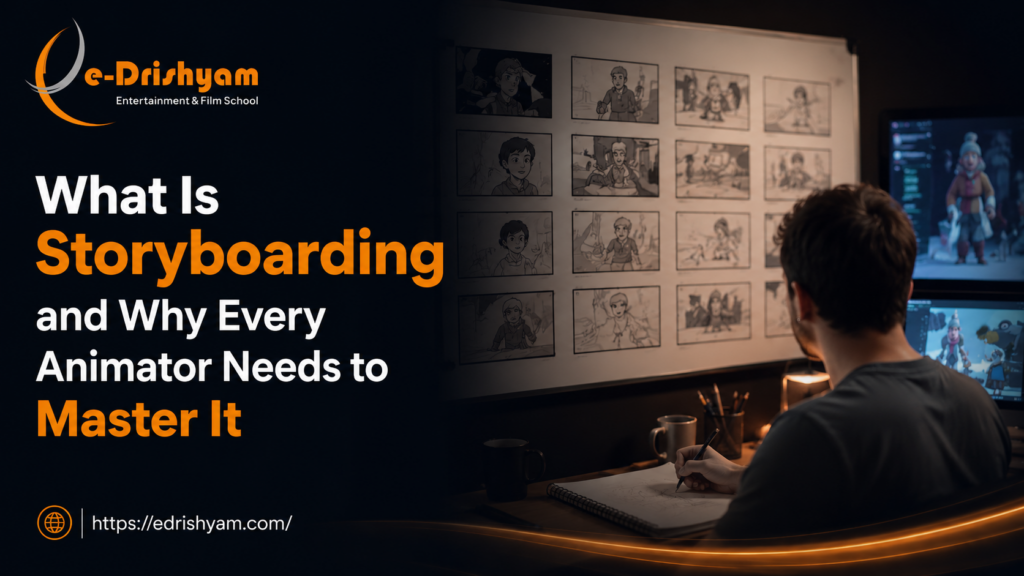
Great animation rarely begins inside animation software storyboarding for animation. It begins with a pencil, a few rough sketches, and a clear vision of how a story should unfold.
Ask any experienced animator about the biggest mistake beginners make, and you’ll hear a familiar answer: they jump straight into animating. Without proper , scenes often feel disconnected, camera angles become confusing, and hours of work are spent fixing problems that could have been identified in the planning stage.
Storyboarding isn’t just another step in the production pipeline. It’s where ideas take shape before they become moving visuals. At e-Drishyam, we’ve seen students transform their storytelling skills simply by understanding how to plan before they animate. It’s one of the reasons storyboarding remains a core skill across animation, filmmaking, gaming, advertising, and visual effects.
If you’re serious about building a career in animation, mastering storyboarding is one of the smartest investments you can make.
What Is Storyboarding?
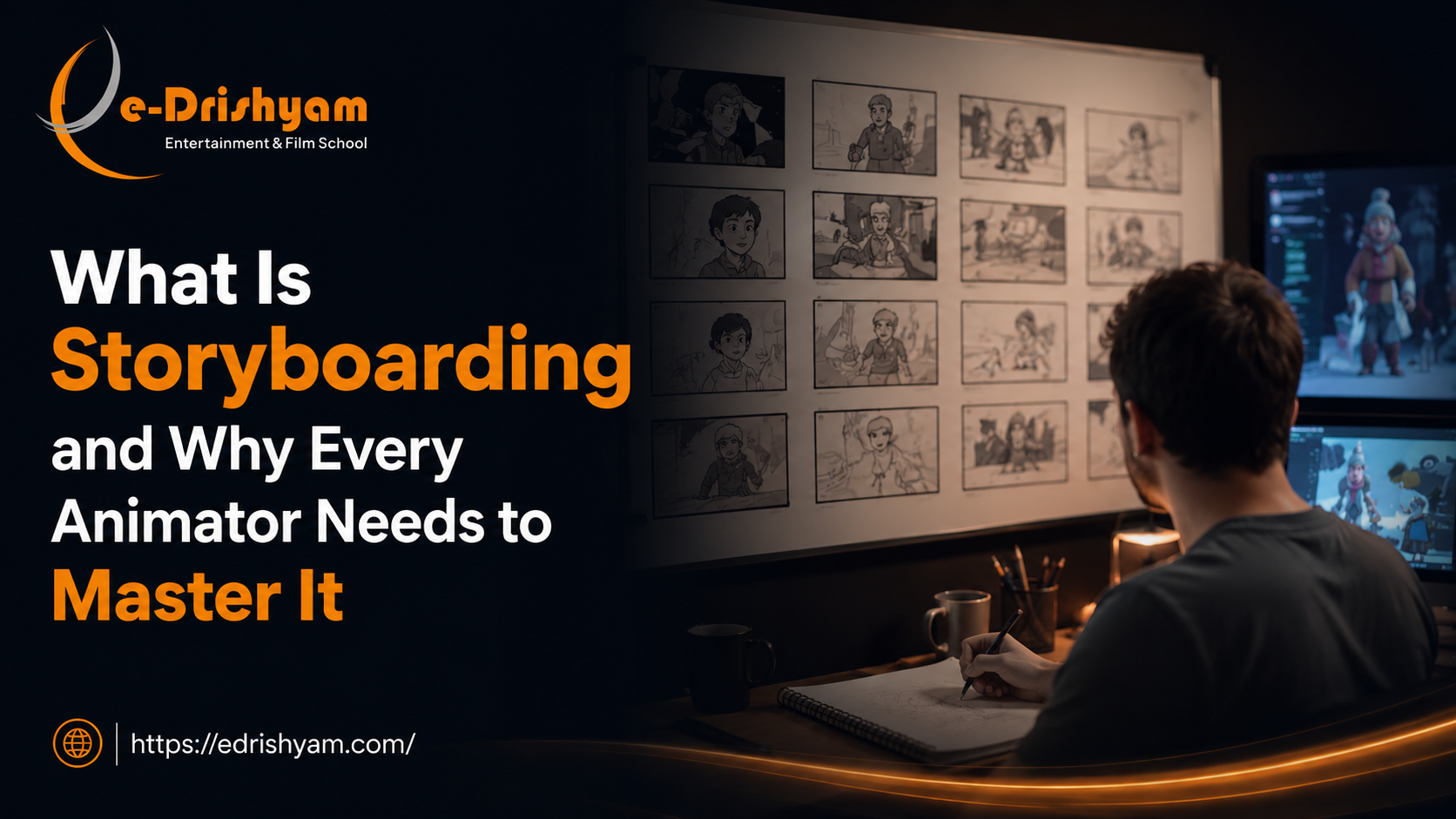
A storyboard is a visual sequence of sketches that maps out an animation or film before production begins. Think of it as a comic strip that shows how each scene will look, where the camera will be placed, how characters will move, and how the story progresses.
Instead of creating finished artwork, storyboard panels focus on communicating ideas clearly. Every frame answers important questions:
- What is happening?
- Who is in the scene?
- Where is the camera positioned?
- How does the action move from one shot to the next?
This planning process allows directors, animators, editors, and clients to understand the story before investing time in full-scale production.
Why Storyboarding Matters in Animation
Animation is one of the most time-intensive creative processes. Even a few seconds of polished animation can require days of work.
That’s exactly why storyboarding for animation is so valuable.
It Prevents Expensive Mistakes
Imagine spending hours animating a sequence only to realise the camera angle doesn’t support the emotion or the scene transition feels awkward.
A storyboard helps identify these issues early, when changes take minutes rather than days.
It Improves Visual Storytelling
Animation isn’t just about making characters move. It’s about guiding the audience’s attention.
A well-planned storyboard helps determine:
- Which shot creates suspense
- When to use close-ups
- How to reveal important information
- How scenes flow naturally
The better the storyboard, the stronger the storytelling.
It Makes Team Collaboration Easier
Professional animation involves multiple artists working together.
Storyboard artists, animators, lighting artists, editors, sound designers, and directors all rely on storyboards as a common visual language.
Without one, every department interprets the script differently.
It Saves Production Time
Planning may seem slower at first, but it dramatically speeds up production.
Many professionals say that investing more time in storyboarding saves significantly more time during animation because fewer revisions are required later.
How to Make a Storyboard for Animation
One of the most common questions beginners ask is how to make a storyboard for animation. The good news is that you don’t need exceptional drawing skills to create an effective storyboard.
Here’s a simple workflow.
1. Understand the Script
Before drawing anything, read the script several times.
Focus on:
- Main actions
- Character emotions
- Important dialogue
- Scene transitions
- Camera moments
The goal is to understand the story rather than immediately illustrating it.
2. Break the Story into Individual Shots
Every camera change usually becomes a new storyboard panel.
For example:
- Wide establishing shot
- Character enters
- Close-up reaction
- Action sequence
- Final reveal
Thinking in shots helps organise the visual flow.
3. Sketch the Main Frames
Don’t worry about creating polished illustrations.
Simple stick figures often work perfectly.
The purpose is clarity, not artistic perfection.
4. Add Camera Directions
Each panel should include notes such as:
- Camera movement
- Zoom
- Pan
- Tilt
- Character movement
- Dialogue
- Timing
These notes help everyone involved understand the intended sequence.
5. Review the Story Flow
Here’s where things get interesting.
Many first-time storyboard artists discover pacing problems only after placing all their panels together.
Review the entire sequence and ask yourself:
- Does the story flow naturally?
- Are transitions smooth?
- Is every shot necessary?
- Does the audience always know where to look?
Small adjustments here can dramatically improve the final animation.
Essential Storyboarding Techniques Every Animator Should Learn
Good storyboard artists don’t simply draw scenes. They control how audiences experience a story.
Here are some of the most important storyboarding techniques used by professionals.
Composition
Every frame should guide the viewer’s eye toward the most important element.
Using composition effectively makes scenes feel intentional rather than cluttered.
Camera Angles
Different angles create different emotions.
For example:
- Low angles create power
- High angles create vulnerability
- Close-ups build an emotional connection
- Wide shots establish location
Choosing the right angle changes how audiences interpret the scene.
Visual Continuity
Characters should move consistently between shots.
If someone exits from the right side of one frame, they shouldn’t suddenly appear from the opposite direction unless the story intentionally changes perspective.
Maintaining continuity keeps viewers immersed.
Clear Silhouettes
Professional storyboard artists often simplify character poses so actions remain readable even without detailed artwork.
If a viewer can understand a character’s action just from the silhouette, the pose is usually effective.
Rhythm and Pacing
Not every scene needs rapid cuts.
Some moments benefit from slower pacing, while action sequences require faster transitions.
Storyboards help establish this rhythm long before animation begins.
Why Storyboarding Is a Career Skill, Not Just a Classroom Exercise
Many students assume storyboarding is only useful during training.
The reality is very different.
Studios actively seek professionals who understand storytelling, the language of the camera, and cinematic thinking.
Storyboard artists work across:
- Animated films
- Television
- OTT content
- Advertising
- Gaming
- Motion graphics
- Explainer videos
- Visual effects production
Strong storyboard skills also make animators more valuable because they understand the “why” behind every movement, not just the software used to create it.
Should You Consider a Storyboard Artist Course?
Learning independently is certainly possible, but structured guidance often accelerates growth.
A good storyboard artist course teaches far more than drawing.
Students learn:
- Visual storytelling
- Shot planning
- Camera language
- Character staging
- Scene continuity
- Script interpretation
- Professional production workflows
At e-Drishyam, practical learning sits at the heart of every media and animation programme. Students work on industry-oriented projects under experienced mentors, giving them exposure to real production processes rather than only software tutorials. This hands-on approach helps learners understand how storyboarding fits into the complete animation pipeline and prepares them for professional opportunities.
Common Storyboarding Mistakes Beginners Make
Every animator starts somewhere, but avoiding these mistakes can speed up your progress.
Focusing Too Much on Beautiful Drawings
A storyboard isn’t an illustration competition.
Simple sketches that communicate ideas effectively are often more useful than highly detailed artwork.
Ignoring Camera Movement
Many beginners only draw characters and forget to indicate how the camera moves.
Camera direction is an essential part of visual storytelling.
Making Every Shot Similar
If every panel uses the same framing, the animation becomes visually repetitive.
Varying shot sizes and angles keeps viewers engaged.
Skipping Planning Entirely
This is probably the biggest mistake.
Many beginners open animation software immediately, only to realise halfway through that the story isn’t working.
Professional productions always invest time in planning first.
Final Thoughts
The difference between average animation and memorable animation often comes down to planning.
Learning how to make a storyboard for animation isn’t simply about sketching scenes. It’s about thinking like a storyteller, understanding cinematic language, and making creative decisions before production begins.
As you continue exploring different storyboarding techniques, you’ll notice your animations becoming clearer, stronger, and more engaging. And if you’re considering a storyboard artist course, look for one that combines creative fundamentals with practical production experience, because that’s where classroom learning begins to reflect real industry workflows.
At e-Drishyam, students are encouraged to build these skills through hands-on projects, mentorship from industry professionals, and practical learning that mirrors the demands of today’s animation and media industry. For aspiring animators, mastering storyboarding isn’t just another skill to add to a résumé. It’s the foundation upon which every great animated story is built.