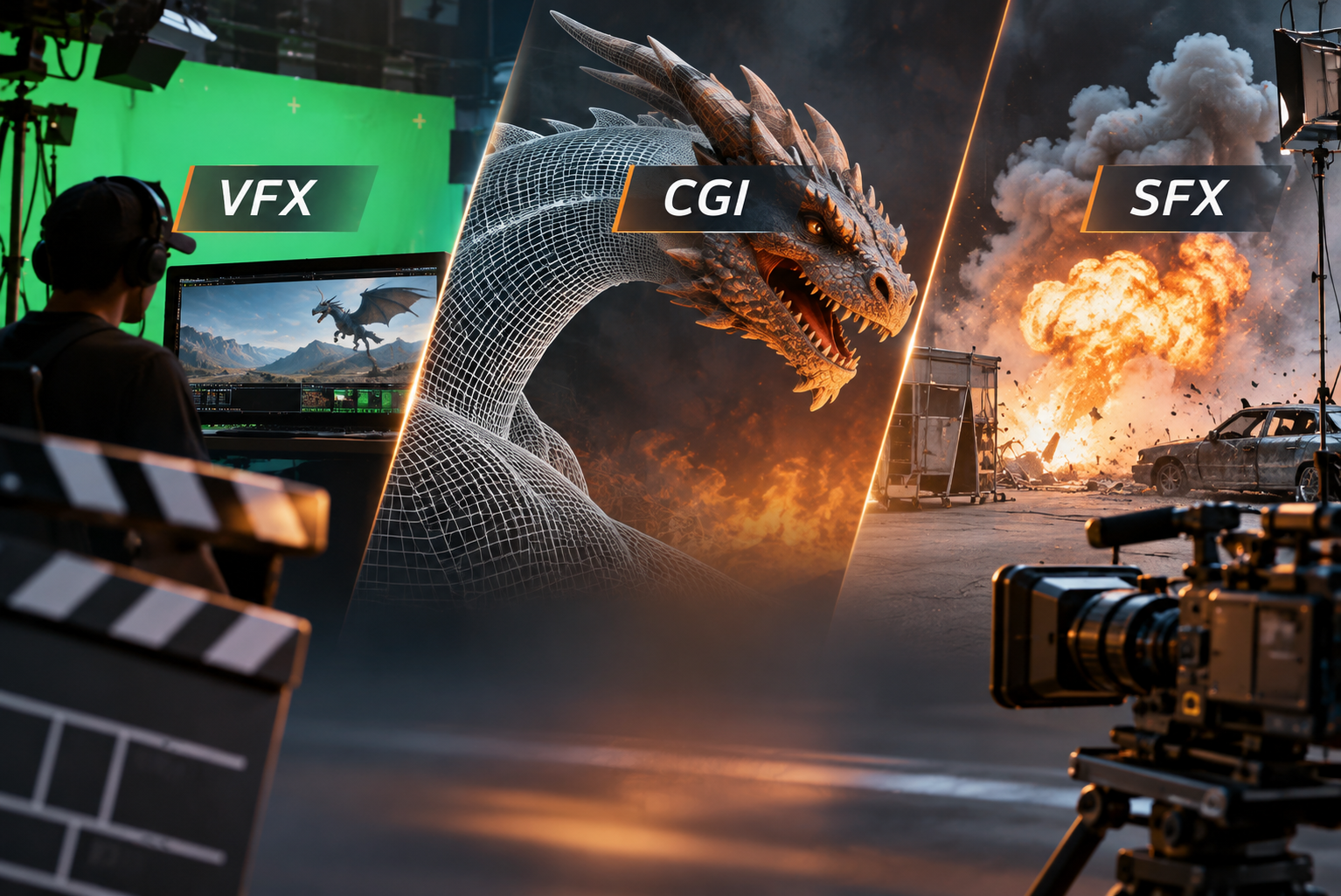

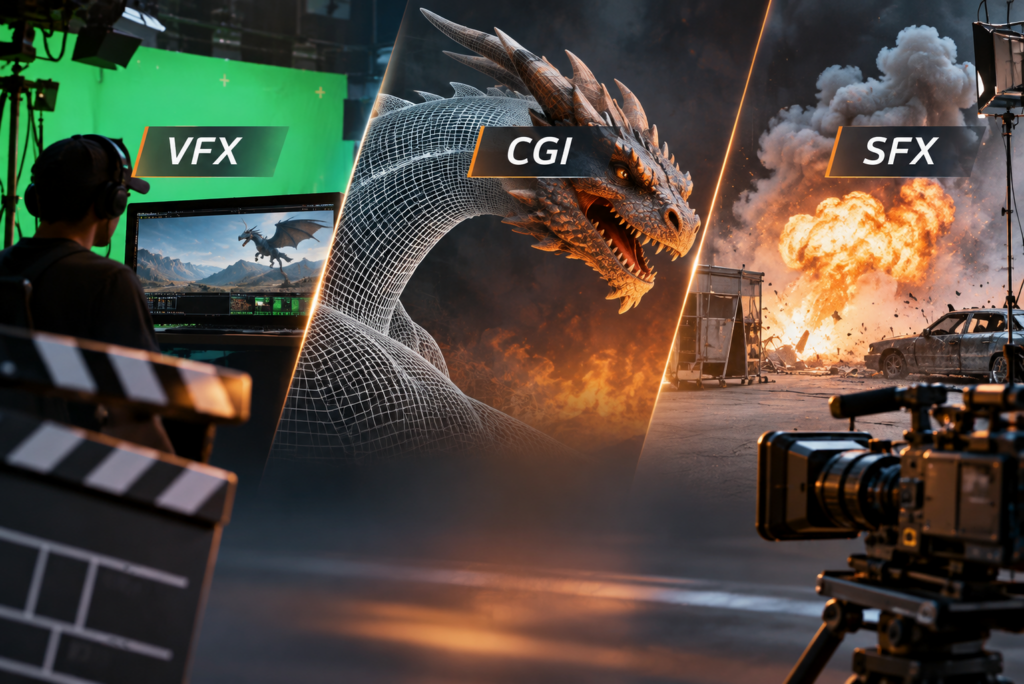
Ask three people how a car flip in a film was done and you’ll probably hear three different answers: VFX, CGI, special effects. Each one sounds reasonable. Each one might be partly right, which is exactly why the terms get mixed up so often.
They aren’t interchangeable, though. They describe different stages, different crews and different tools. Once you can tell them apart, film credits start making sense, and so does the career path if you’re weighing a VFX course in Thane.
What Is SFX in Movies? Effects You Could Have Touched
SFX is short for special effects: things created physically, on set, in front of the camera. If a crew built it, rigged it or set it off in real life, it’s SFX. (In audio work, the same letters can mean sound effects. Here, it means the physical kind.)
Special effects in filmmaking cover explosions, rain and snow rigs, fog, fire, breakaway glass, prosthetics, animatronic creatures, miniature models and wire work for stunts. The camera records them as they happen, so actors react to something real. In Inception, the corridor fight was shot on a set built to rotate, which is why the bodies tumble so convincingly. Mad Max: Fury Road staged much of its vehicle action for real, with digital work added afterwards. Practical effects also bring free realism: a real fire lights an actor’s face and the set around them without anyone having to simulate it, while a digital fire has to be told how to behave.
What Is VFX in Filmmaking? Work Done After the Camera Stops
VFX is shorthand for visual effects: imagery created or altered after filming, by combining live-action footage with other elements until it all reads as one shot. Visual effects in movies range from invisible repairs to entire fantasy worlds. If SFX is what happens in front of the lens, VFX is what happens to the footage afterwards.
The main types of visual effects include:
- Compositing: layering footage, CG elements and backgrounds into one final image
- Rotoscoping: tracing around an object frame by frame so it can be isolated
- Keying: removing a green or blue screen so a new background can sit behind the actors
- Matchmoving: tracking the real camera’s movement so digital elements stay locked to the scene
- Set extensions and matte paintings: stretching a small set into a street, a palace or a skyline
- Clean-up: erasing wires, rigs, crew reflections and stray signboards
These are the VFX techniques in movies that audiences rarely notice, which is the point. Plenty of VFX work is repair and quiet support, not monsters.
What Is CGI in Movies? The Computer-Built Part of the Frame
CGI means computer-generated imagery: characters, objects or environments built inside software instead of photographed. A CGI artist might model a creature in 3D, texture its skin, rig it with a digital skeleton, animate it, light it and render it out as frames. Fully animated films are almost entirely CGI, since there’s no live footage to blend into.
In live-action films, CGI is a tool, and VFX is the larger process that uses it. Building the creature is CGI. Taking that rendered creature and blending it into a real location is VFX. Terminator 2 (1991) gave audiences the liquid-metal T-1000, one of the best-known early CG characters. Gollum in The Lord of the Rings went a step further, pairing an actor’s motion-captured performance with a digital character.
VFX Animation: Where CGI Gets a Performance
VFX animation is the animation work inside a VFX pipeline, and it splits into two quite different jobs. Character animators give a CG creature weight, timing and emotion, so it’s closer to acting. FX artists simulate fire, smoke, water and destruction, so it’s closer to physics. Both use the same software, but the thinking is different. A character animator worries about where a creature’s weight sits when it steps. An FX artist worries about how smoke should curl around a wall. Most artists lean toward one.
SFX, VFX and CGI Side by Side
| SFX | VFX | CGI | |
| Stands for | Special effects | Visual effects | Computer-generated imagery |
| Made | On set, during filming | In post-production | In software, before compositing |
| Nature | Physical, practical | Combining and altering footage | Digital models and animation |
| Examples | Explosions, rain rigs, animatronics | Green screen, wire removal, set extensions | 3D creatures, digital crowds, digital environments |
One Shot, Three Departments
Jurassic Park (1993) shows all three working on a single film. Stan Winston’s studio built animatronic dinosaurs for close shots, which is SFX. Industrial Light & Magic created the digital dinosaurs seen moving at full scale, which is CGI. Those digital animals were then composited into the live plates, and the cuts between the two kinds of dinosaur are hard to spot. That integration is VFX. Most big productions work this way: real effects where they can, digital work where they must.
Career in VFX: Where the Three Meet a Job Title
A career in VFX sits mostly on the post-production side. Typical roles include rotoscoping artist, paint artist, matchmove artist, compositor, FX artist, lighting artist and CG animator. Rotoscoping and paint are common starting points for new artists, who then move toward compositing. SFX is a separate route, usually through set construction, makeup, prosthetics and stunt rigging. Hiring on the VFX side leans heavily on showreels, so a short reel of clean, finished shots counts for more than a long list of software names.
That’s why a VFX course in Thane should teach the pipeline, not a single tool. At e-Drishyam, the VFX course in Thane begins with Nuke, the node-based compositing software, and covers After Effects, Silhouette, 3D Equaliser and PFTrack, along with rotoscoping, VFX paint, keying, match moving and CG compositing. Students build a showreel as part of the course. For the modelling and animation side of CGI, the 3D Animation course covers modelling, texturing, rigging, lighting and rendering. Placement assistance is offered, though not guaranteed.
Remember It This Way
SFX is what the camera captures. VFX is what’s done to the footage. CGI is one of the tools VFX uses. Say that out loud once, and the next time a film credits special effects and visual effects separately, you’ll know why.
If you’re comparing a VFX course in Thane, the easiest way to see how this works in a real training room is to book a free demo at e-Drishyam in Thane West and ask the team where you’d fit.