
For decades, a final VFX shot meant the team would go on a long break. An artist set up a scene, hit render, and came back hours later to see whether the lighting worked; if that did not suffice, the team’s rigorous process would repeat all over again. Unreal Engine virtual production flips that routine: the background is rendered live, on set, while the camera rolls. The director sees the finished frame on the monitor, not in a review session weeks later. That shift is why people now say real-time can effectively replace offline rendering. It is partly true, and the part that is not true or rather does not correlate, also matters.
Inside the LED Volume: Unreal Engine as a Film Set
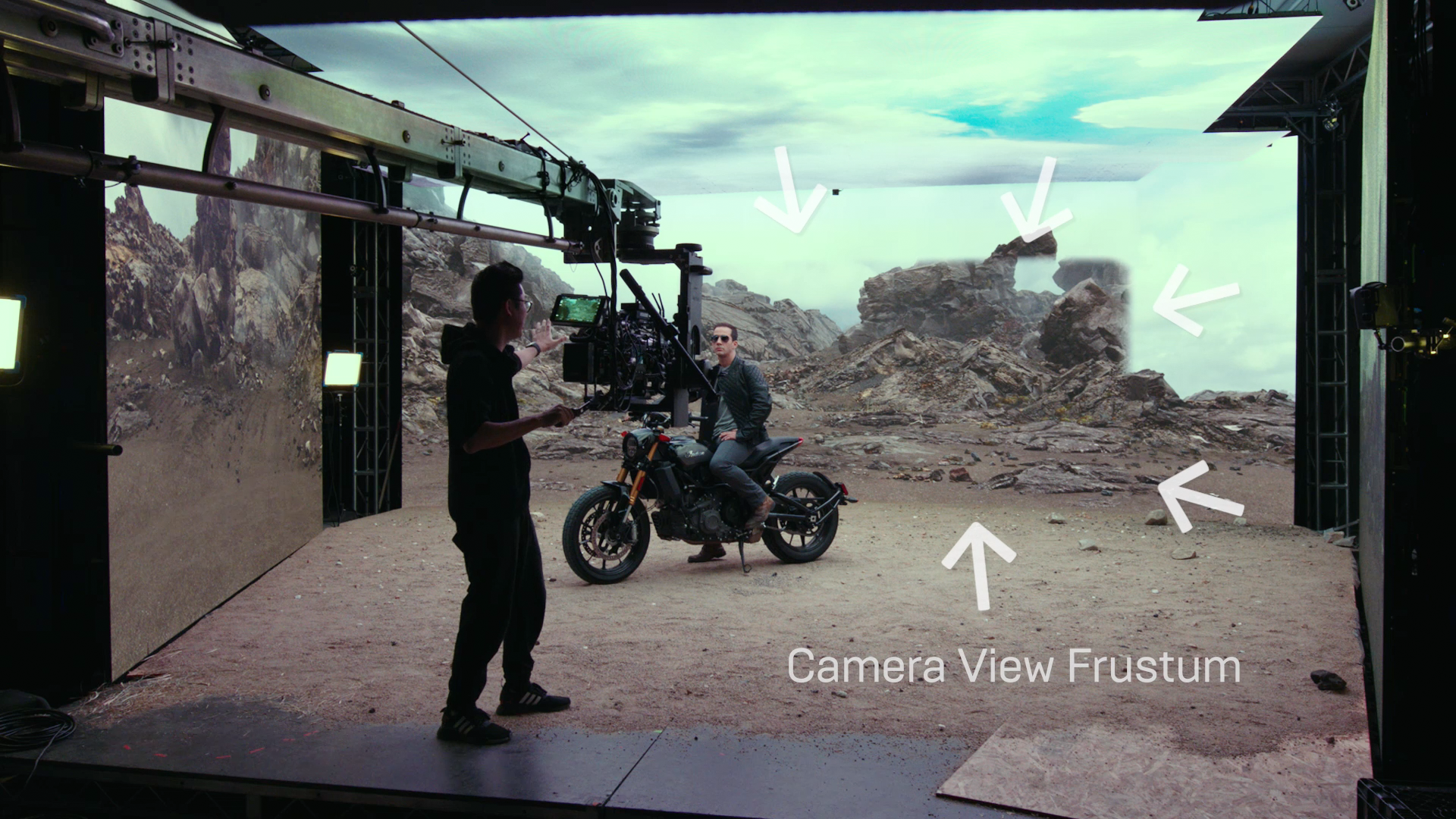
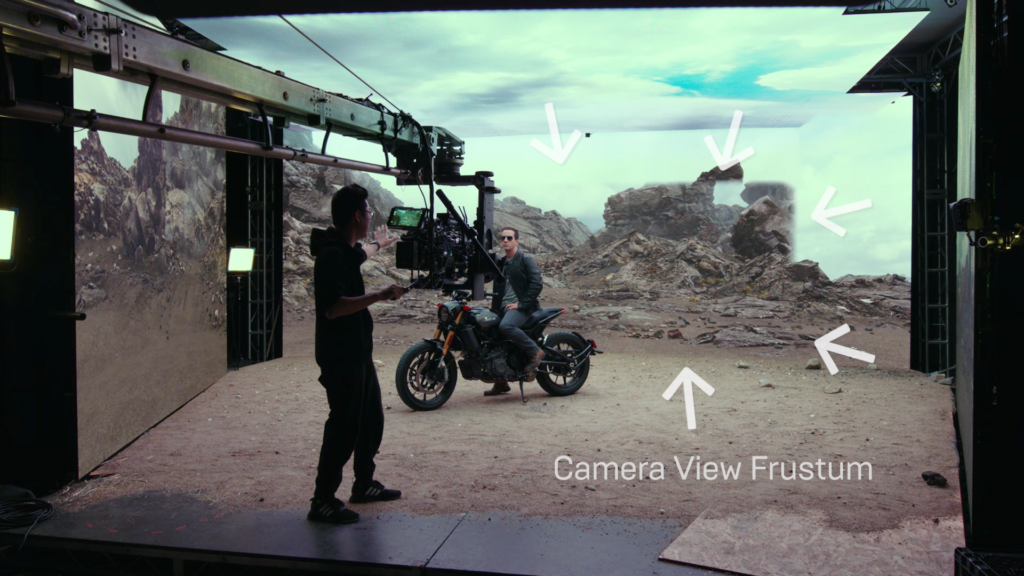
Think of it as a very precise projector. Actors stand in front of a large wall of LED panels (often with more panels overhead), and the wall shows a 3D world that Unreal Engine draws in real time. A system tracker follows the camera, so the engine always knows where the lens is and which way it precisely points. Whatever part of the wall falls inside the camera’s view gets redrawn from that exact position, which is why the perspective shifts correctly when the camera moves. Epic calls this patch the inner frustum. The rest of the wall, the outer frustum, is not captured by the camera. Its job is to throw light and reflections back onto the actors and the set, so a character standing in front of a sunset is actually lit by that sunset.
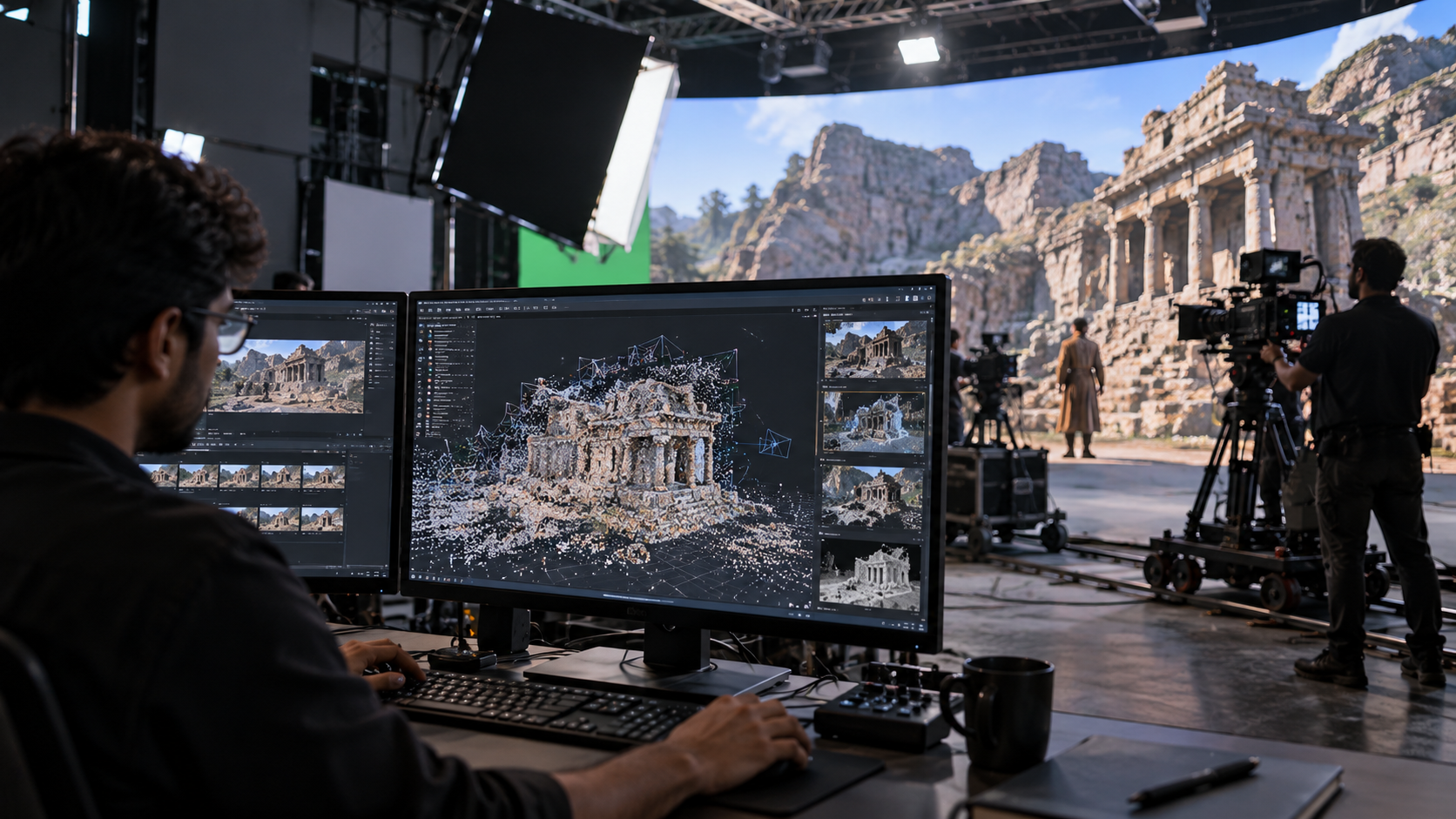
Epic’s own documentation describes the aim as getting final pixels in camera, with no green screen compositing afterwards. Actors benefit too. They can see the world they’re supposed to be standing in, and reflections on costumes and props come from the wall itself, which is hard to fake later. Most people first heard about this through The Mandalorian, whose stage ran on Unreal Engine and became the reference point for everything since.
Lumen and Nanite: What Unreal Engine 5 Changed
Early volume stages ran on Unreal Engine 4, and artists often spent time baking lighting and simplifying geometry so the wall could hold its frame rate. UE5 shifted some of that burden. Nanite lets the set and scene carry very great geometric detail without hand-built level-of-detail meshes. Lumen handles global illumination and reflections dynamically, so just a slight movement of light or a time change of day doesn’t mean a re-bake. Epic’s 5.0 release notes even flagged Nanite support for the nDisplay pipelines used on LED stages, still in beta.
The practical result is that a cinematographer can ask for a different light without waiting on a long bake. That’s a real change in how a set behaves, and it’s why an Unreal Engine virtual production day can feel closer to a normal shoot than a tech demo.
Offline Isn’t Replaced: Where the Path Tracer Still Wins
The headline skips something really important: a feature that resembles the initial style; Unreal has its own offline mode. Movie Render Queue renders image sequences one frame at a time, and beside it sits the Path Tracer, which builds each image by sample collection over time rather than physically drawing it in an instant. Epic’s docs say to use Movie Render Queue for final path-traced output. So if a studio needs glass and hair to look as accurate as possible, it can take the slower route without leaving the engine.
What is actually being replaced is the default. Previsualisation, look development, cutscenes, many commercials and in-camera backgrounds can now go to final without the traditional offline render queue. Hero shots with heavy volumetrics or complex hair may still earn the longer render. A good supervisor decides shot by shot.
Unreal Engine Virtual Production Arrives in India
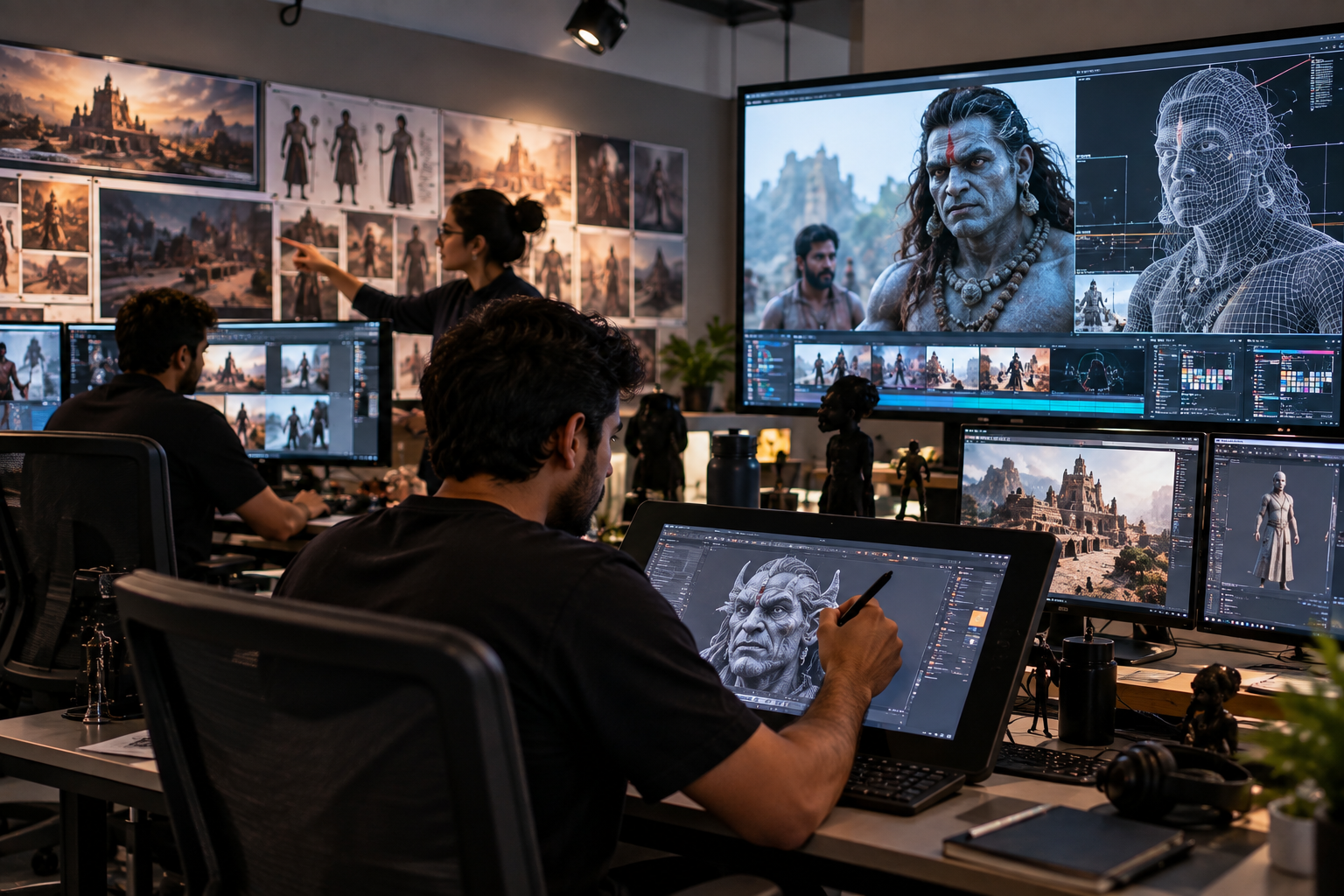
This isn’t only a Hollywood story. Annapurna Studios and Qube Cinema announced plans for a permanent LED virtual production stage in Hyderabad in 2022, built around Unreal Engine’s rendering features. Mumbai also has studios that offer LED-stage commercial shoots and Media Production. Monks India has run open-house workshops on its own volume near Delhi. Wherever the stage sits, it needs people who can build environments and optimise them for real-time performance. Those are the skills behind Unreal Engine virtual production work, and they sit somewhere between traditional 3D art and game development.
What Makes or Breaks an LED Shoot
A volume looks forgiving on a showreel and unforgiving in practice. Everything on a stage has to run on the same clock, which is why Epic’s documentation gives timecode and genlock a section of their own. Several machines usually form an nDisplay cluster, each driving a slice of the wall, so a stage is as much a network and sync problem as an art one. Refresh rate matters because a slow wall can flicker on camera, and pixel pitch, the spacing between LEDs, decides how close the camera can get before the wall stops looking like a world.
Colour needs attention too. What the eye sees on the wall isn’t necessarily what the sensor records, so teams calibrate the wall for a specific camera, and Epic’s workflow leans on OpenColorIO for that. Skipping that step is how a beautiful Unreal scene turns slightly wrong on screen.
Learning Unreal Engine Virtual Production Without a Stage
You don’t need a stage to start. Epic’s In-Camera VFX Production Test sample project includes a simple nDisplay config so you can view its scenes on a single computer, with no LED volume attached. Open it, study how the scenes are built, and you’ll pick up plenty. Then build your own small environment, light it with Lumen, and render it two ways: once in real time, and once through Movie Render Queue. Comparing the two teaches you what the real-time image skips and what it keeps.
A short set of habits pays off early. Keep scene complexity in check so the frame rate stays steady. Practise matching a virtual light to a real one on a reference photo. None of this needs a stage, though a capable GPU helps.
From the e-Drishyam Team: Pick one film you love and try to guess which shots were built in camera and which were added later. It trains your eye faster than you’d expect, and a trained eye is half the job.
Real-Time Where It Fits, Offline Where It Counts
Real-time rendering is taking over more and more final shots, though offline hasn’t disappeared. The sensible position is somewhere in the middle: the engine renders live when the shot allows it, and a slower, higher-quality pass remains available when the shot demands it. Artists who understand both sides will be the ones studios want. If you’re building that skill set, Unreal Engine virtual production is a practical place to start, and it’s worth learning alongside the compositing and 3D fundamentals that every shot still depends on. Curious how this fits into VFX training? Book a free demo at e-Drishyam in Thane West and ask the team.