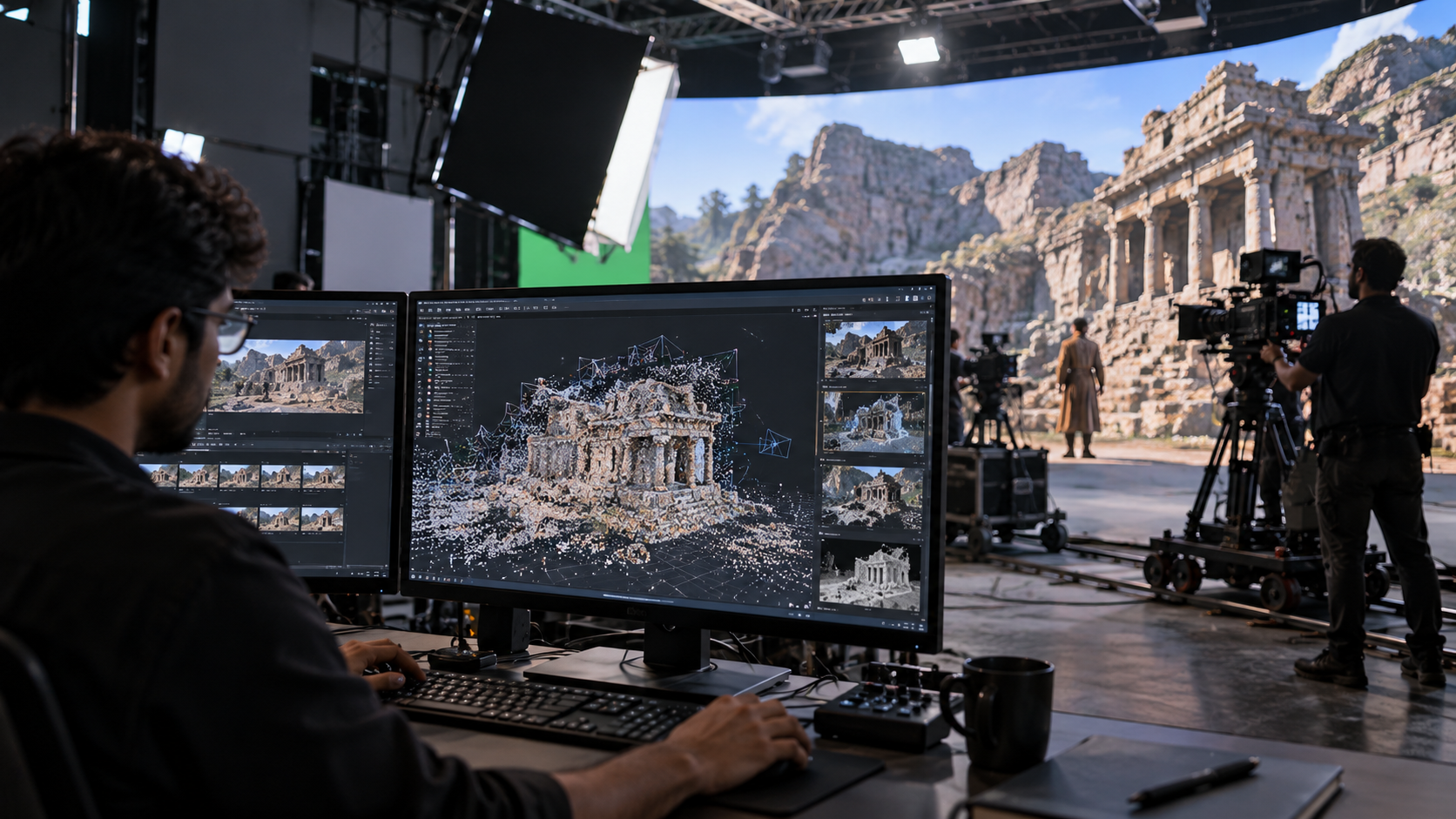

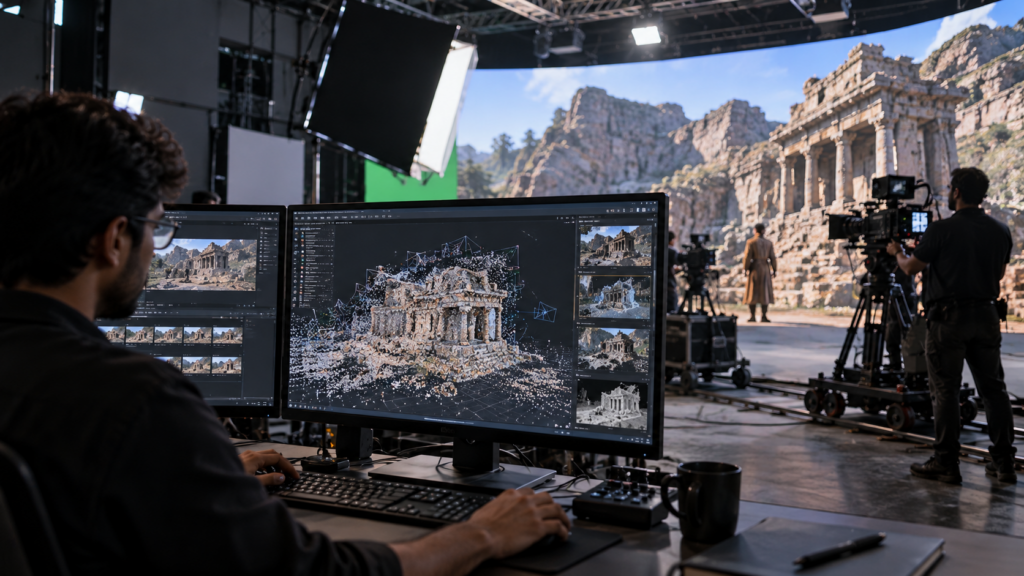
It’s at times difficult to rebuild a real location in 3D. One person models the street, another textures the walls, and weeks go by before a camera can move through it. Gaussian splatting changes that workflow; the aim is to make it operationally easy. You film a space with a phone or a camera, let software process the footage, and get back a 3D scene you can fly through. It looks odd the first time you see it, but with proper procedure followed. It’s also already showing up in real productions.
Take a set of ordinary photos of a place or an object, and Gaussian splatting turns them into a 3D scene you can move through live, from angles nobody actually shot. What people notice first is how real it feels. Light, depth and the way a surface changes as your viewpoint shifts all carry over, where older scanning methods tend to flatten them. The technique only appeared in 2023, out of university research, and it has developed quickly since. NeRF and photogrammetry are the usual points of comparison. Splats generally render faster and look realistic, though you pay for that when you need to edit the result.
What Gaussian Splatting Actually Is
Picture millions of tiny, soft, semi-transparent blobs of colour floating in space. Each one has a position, size, orientation, opacity, and a colour that can shift with your viewing angle. Draw them all together, and you get a photorealistic image. It has no polygons or UV maps anywhere.
The method comes from a 2023 SIGGRAPH paper by researchers at Inria – a research institute in France- and its most significant point was speed. Earlier radiance field techniques like NeRF looked great but rendered slowly. Splats render in real time, which is why they moved from research labs to artists’ desktops within about two years.
It also helps to compare it with photogrammetry, which most VFX students hear about early. Photogrammetry builds a mesh and bakes textures onto it, and it struggles with hair, foliage, glass and shiny surfaces. Splats cope with those far better because they never try to define a hard surface. That’s also their weakness, and we’ll get to it.
Where Studios Are Already Using It
The clearest proof of its usage is seen on screen. A$AP Rocky’s “Helicopter” video recorded almost every human performance volumetrically on a 56-camera Evercoast rig, then rendered it as moving splats. Evercoast’s workflow was reused months later on NouerA’s “.exe” music video, shot with 21 cameras in Seoul, so this isn’t a one-off stunt. James Gunn’s Superman reportedly used 4D Gaussian splatting for the Kryptonian hologram message, letting the effects team offset and rotate individual splats to create a glitching look. A 4D splat is simply one that moves over time.
Software makers have noticed. Nuke 17, released in February 2026, supports splats natively, and Houdini 21 also has early native support. The free GSOPs toolset from CG Nomads adds deeper editing inside Houdini, and Blender users can try add-ons such as KIRI Engine.
Day to day, the work is less glamorous than a Hollywood hologram. Previs teams drop a scanned location into Unreal so a director can test camera angles before the shoot. Compositors use splats as quick 3D backdrops for camera moves through a photographed space. Set extension and reference capture are being tried too. Nobody serious is claiming it replaces a modelled hero asset.
The Rough Edges: What Gaussian Splatting Can’t Do Yet
This is where the hype usually stops, so let’s be straight. A splat scene has no clean surface, and the capture bakes in the lighting. The relight system exists in some tools, but its scope is still limited; it’s not a solved problem. Anywhere your cameras did not look turns into haze or stray blobs called floaters, so sloppy shooting shows up fast. Pipeline support is young as well. When and where to drop a splat file into a shot is still less predictable than an Alembic cache import.
Hardware matters to a great extent in this, many desktop training tools expect an NVIDIA GPU, so a basic laptop can bottleneck your workflow. Cloud and phone-based apps exist for that reason, though you will trade some control for convenience.
Why it’s worth learning as a VFX student
Studios hire for problems, and cleaning raw splat captures into usable assets is a new one. One online academy that sells a course on the subject says studios have started hiring radiance field specialists. Read that as a signal, not a promise. The roles are still few.
The entry point is cheap. Shoot a slow walk-around of an object on your phone, train it in a free or low-cost tool, tidy it in SuperSplat (a free browser editor), and bring it into Blender or Unreal. Shoot more than you think you need. Move slowly with steady exposure, and circle the subject so you see every surface from several angles. Skip mirrors and moving people on your first attempts.
Camera to Compositing: How a Splat Gets Into Your Shot
The workflow is less mysterious than it sounds. First comes capture: often a few hundred overlapping frames from video or stills. Next, software works out where the camera was for each frame, a step VFX artists will recognise as a camera solve. Then a trainer fits the splats to those frames, which is the slow, GPU-hungry part. After that comes cleanup: you crop the scene, delete floaters, and fix colour. Only then does the file travel to Nuke, Houdini, Blender or Unreal, usually as a .ply file.
A lot of guides stop at the tools. They skip that much of the work after capture is ordinary VFX thinking. Tracking, clean plates, colour matching and edge judgement all apply, and a splat that doesn’t match the lens or grade of the live footage will sit in the shot like a sticker.
Where this sits next to your VFX training
If you’re on the VFX track or the Master Diploma in Animation & VFX at e-Drishyam, this isn’t a separate career path. It builds on the fundamentals: camera tracking, compositing, 3D basics, and a trained eye for what looks wrong in a frame. Gaussian splatting won’t rescue weak foundations. An artist who can’t read a camera solve will struggle with a splat just as much. Treat it as a side project to try once those basics are in place.
From the e-Drishyam Team: Try one small capture this week. A phone, a table and a slow walk-around is enough to see why people are excited, and where the rough edges are.
The Honest Verdict – Is It Just Hype Or Real?
Gaussian splatting won’t take over VFX next year. It’s a young tool with real gaps in lighting and pipeline support. But it’s also the first capture method in a while that puts realistic 3D within reach of one person with a camera, and studios are testing it on actual shots. Learning Gaussian splatting now, next to solid tracking and compositing, means you won’t meet it cold on your first job.
Curious where it fits in your own VFX career? Book a free demo at e-Drishyam in Thane West and talk it through with the team.