
Some of the most unforgettable characters in modern cinema were never physically on set.
The towering Na’vi in Avatar, the expressive apes in Planet of the Apes, and many creatures in blockbuster films all began with a real actor performing in a specially designed motion capture suit. Every expression, gesture, and movement was first performed by a human before being captured as a digital character.
This process, known as motion capture animation, has transformed the entertainment industry. It lets filmmakers and game developers to create realistic performances while giving artists the creative freedom to build characters that couldn’t exist in the real world.
For aspiring animators and VFX artists, understanding motion capture animation is becoming increasingly important. As the demand for high-quality digital content continues to grow, professionals who understand how motion capture fits into the production pipeline have a valuable advantage. At e-Drishyam, students are introduced to industry-relevant animation and VFX workflows through practical learning, helping them understand how technologies like motion capture contribute to modern visual storytelling.
What Is Motion Capture Animation?
Motion capture, often shortened to “mocap,” is the process of recording an actor’s physical movements and converting them into digital data. That data is then applied to a 3D character, allowing the character to move naturally while preserving the actor’s original performance.
Rather than animating every movement manually, animators use the captured performance as the foundation. They can then refine, enhance, or stylise it depending on the project’s creative direction.
Motion capture is widely used across:
- Feature films
- Television and OTT productions
- Video games
- Virtual reality experiences
- Commercial advertisements
- Animated films
- Live virtual productions
It’s important to understand that motion capture doesn’t replace animation. Instead, it gives animators a realistic starting point to build on.
How Does Motion Capture Work?
One of the most common questions beginners ask is, How does motion capture work?
While the technology behind it is sophisticated, the overall process follows a clear sequence.
Step 1: The Actor Performs
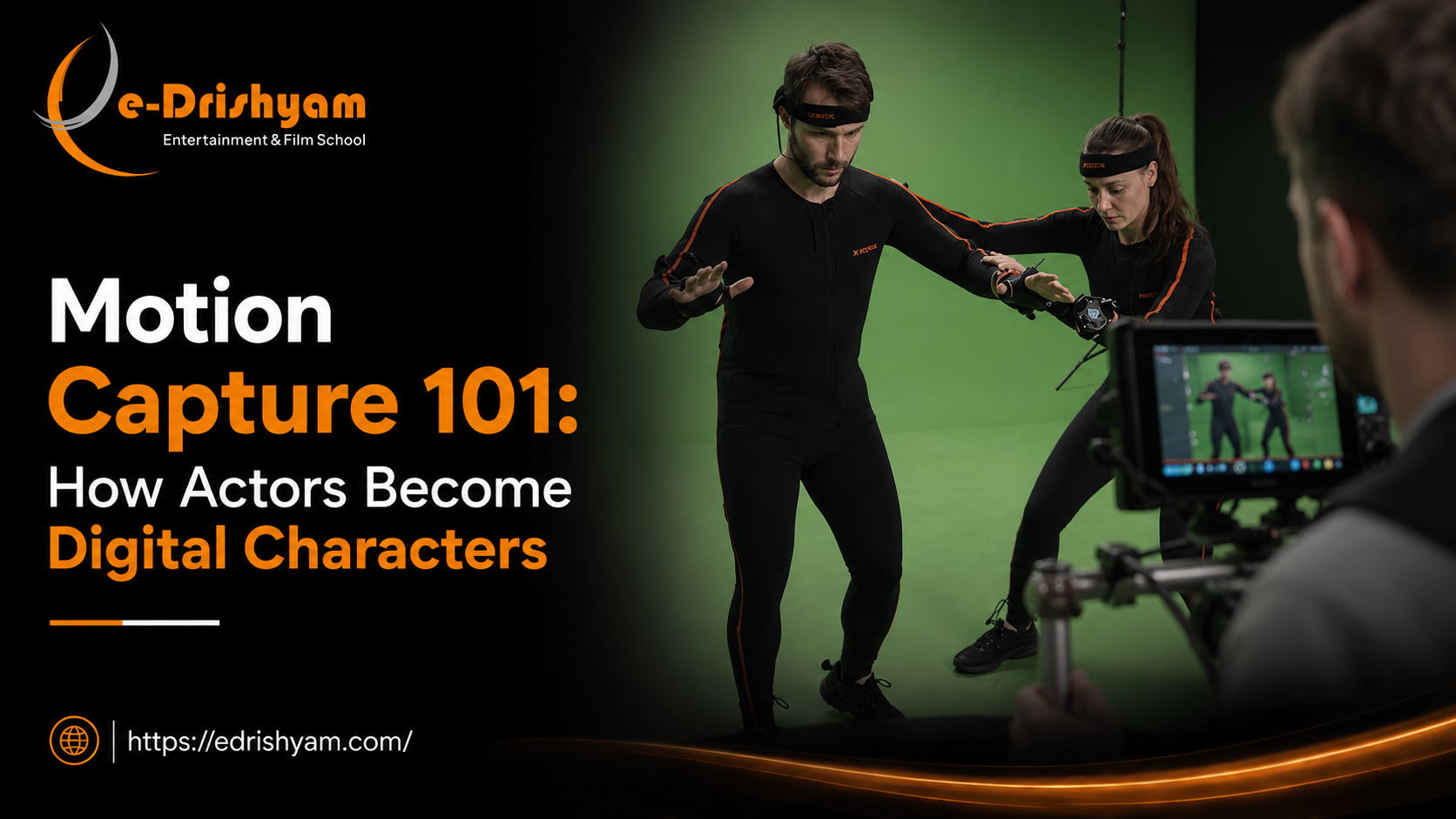
The performer wears a specialised suit fitted with reflective markers or built-in sensors placed at the shoulders, elbows, knees, hips, and wrists.
For facial performances, additional tiny markers or specialised facial cameras capture subtle expressions like smiles, eyebrow movements, and eye motion.
The actor performs exactly as they would on a traditional film set.
Step 2: Cameras Track Every Movement
Multiple high-speed cameras are positioned around the performance space.
These cameras continuously record the location of every marker from different angles, allowing the system to calculate precise 3D movement in real time.
This creates an accurate digital representation of the actor’s motion.
Step 3: The Data Is Processed
The captured marker information is cleaned to remove errors or missing data.
This stage often includes:
- Correcting tracking issues
- Filling missing frames
- Smoothing movement
- Organising the performance
Clean data is essential before moving to animation.
Step 4: Applying Motion to a Digital Character
The processed motion is transferred onto a digital skeleton, commonly called a rig.
Once connected, the digital character performs exactly as the actor did during the recording session.
At this stage, animators begin refining the performance.
Step 5: Animation Refinement
Here’s where things get interesting.
Motion capture provides realistic movement, but animators are responsible for adding personality.
They may exaggerate expressions, adjust timing, improve poses, or enhance dramatic moments to better suit the story.
The final character becomes a collaboration between the actor’s performance and the animator’s creativity.
Why Motion Capture Technology Has Become So Popular
The growth of motion capture technology isn’t simply due to its impressiveness. It solves real production challenges while improving storytelling.
Realistic Character Performances
Human movement contains countless subtle details that are difficult to recreate manually.
Motion capture preserves natural body language, making digital characters feel believable.
Faster Production for Complex Scenes
Animating hundreds of realistic movements by hand can take weeks.
Motion capture records those performances much more quickly, allowing animation teams to focus on refinement rather than building everything from scratch.
Better Collaboration Between Actors and Animators
Actors contribute emotional performances.
Animators enhance those performances for stylised worlds.
Together, they create characters that audiences genuinely connect with.
Consistency Across Large Productions
Major films and games often involve hundreds of shots.
Using motion capture helps maintain consistent movement across different scenes and production teams.
Where Motion Capture Is Used Today
Many people associate motion capture only with Hollywood films, but its applications are far broader.
Today, motion capture technology is used in:
Films
Fantasy creatures, superheroes, digital doubles, and large-scale visual effects all benefit from motion capture.
Video Games
Game developers use motion capture to create realistic combat, sports movements, dialogue sequences, and cinematic cutscenes.
Virtual Production
Modern virtual production combines real-time game engines with motion capture, allowing filmmakers to visualise scenes while actors perform.
Animation Studios
Some animated productions use motion capture as a starting point, then add stylised animation to match the artistic vision.
Medical and Sports Research
Outside entertainment, motion capture helps analyse human movement for rehabilitation, sports performance, and biomechanics.
Does Motion Capture Replace Traditional Animation?
A common misconception is that motion capture has made traditional animation unnecessary.
It hasn’t.
In fact, skilled animators remain essential throughout the process.
Motion capture captures movement.
Animators improve it.
They adjust:
- Character personality
- Facial expressions
- Timing
- Weight
- Exaggeration
- Secondary motion
- Stylisation
What most people don’t realise is that many motion-captured performances still require extensive animation before they’re ready for the screen.
Animation and motion capture work together rather than competing with each other.
Skills Every Future Motion Capture Artist Should Develop
If you’re interested in working with motion capture animation, technical software knowledge is only one part of the equation.
Successful professionals also develop:
Strong Observation Skills
Understanding how people naturally move helps improve both captured and hand-animated performances.
Knowledge of Human Anatomy
Body mechanics influence believable animation.
Knowing how joints, muscles, and weight distribution work makes every movement more convincing.
Acting Fundamentals
Many animators study acting principles because believable animation starts with believable performances.
Animation Principles
Even with motion capture, concepts like timing, anticipation, arcs, and follow-through remain essential.
Software Proficiency
Professionals often work with tools such as Autodesk Maya, MotionBuilder, Unreal Engine, and industry-standard VFX software to process and refine captured performances.
Learning Motion Capture as an Animation Student
If you’re planning a career in animation or visual effects, learning how motion capture technology fits into the production pipeline is becoming increasingly valuable.
At e-Drishyam, students are encouraged to understand the complete creative workflow rather than focusing only on software. Through industry-oriented courses in animation and VFX, practical tasks, live projects, and guidance from experienced mentors, students build both technical expertise and creative problem-solving skills that reflect real production environments. This hands-on approach prepares aspiring artists for careers across films, gaming, advertising, and digital media.
Common Myths About Motion Capture
“The Computer Does All the Work”
Not true.
Motion capture records movement, but artists spend considerable time cleaning data, refining animation, and enhancing performances.
“Only Big Hollywood Studios Use It”
As technology becomes more accessible, motion capture is increasingly being adopted by game studios, independent filmmakers, advertising agencies, and virtual production teams.
“Actors Don’t Matter”
The opposite is true.
Without a convincing performance, even the most advanced technology cannot create an emotionally engaging digital character.
Final Thoughts
The answer to How does motion capture work goes far beyond cameras and sensors. At its core, it’s about capturing authentic human performance and combining it with digital artistry to create characters that audiences believe in.
As motion capture animation continues to shape films, games, and immersive media, professionals who understand both technology and storytelling will remain in high demand. While software and tools continue to evolve, the ability to observe movement, understand performance, and refine animation will always be valuable skills.
At e-Drishyam, aspiring animators and VFX artists gain exposure to these modern production practices through industry-focused learning, experienced faculty, and hands-on training. By understanding where motion capture technology fits within the animation pipeline, students build a stronger foundation for careers in today’s fast-evolving media and entertainment industry.