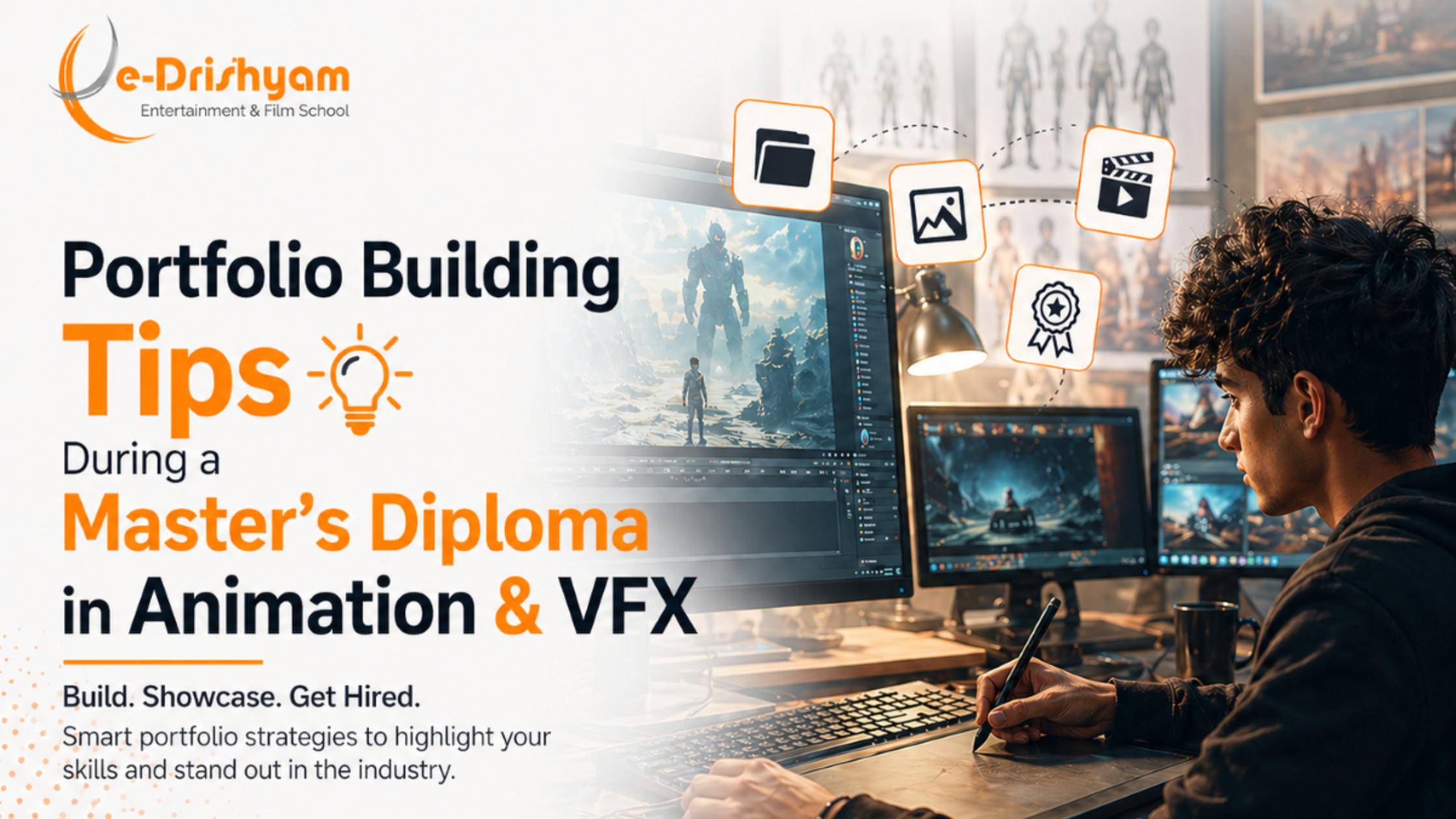
Most students finishing their diploma in animation in Thane with placement make the same mistake: they treat portfolio building as something they’ll do after the course ends. By then, it’s too late to go back and redo work, rebuild scenes, or reshoot a render that was almost good enough. Your portfolio isn’t the finish line; it’s being built right now, one project at a time, whether you realise it or not.
The animation industry doesn’t hire resumes. It hires showreels. When a studio HR opens your application, what they’re looking at within the first 30 seconds is your work, not your grades, not your certifications, not even which institute you attended. The quality of your portfolio is the single biggest factor in whether you get called for an interview.
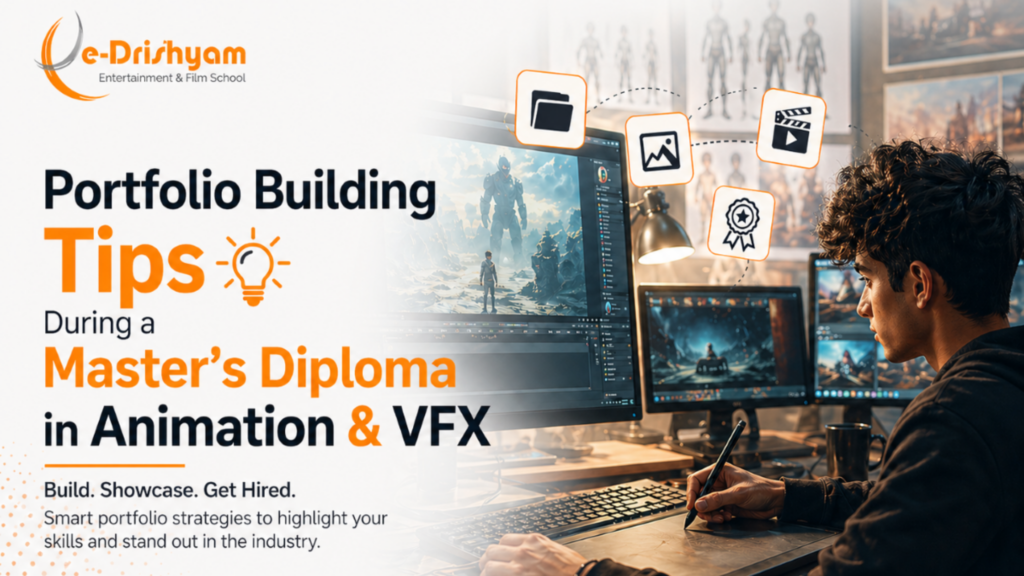
So if you’re currently enrolled in a Master Diploma in Animation and VFX (MDAV), or thinking about it, here’s how to make the most of those 18 to 24 months and come out the other side with a portfolio that actually gets you placed.
Start Thinking Like a Studio from Day One
One of the things we emphasise at e-Drishyam, right from the first module, is this: you are not a student doing assignments. You are a junior professional building work samples. That shift in mindset changes everything: how seriously you approach a brief, how much time you spend on polish, and how often you push past “good enough.”
Studios don’t care how challenging a project was. They care what it looks like when it’s done. A technically simple piece that’s been executed with care and attention to detail will always outperform a complex scene that looks rushed. So from week one of your animation course, start asking yourself: would I be proud to show this to a creative director at Technicolour or Prime Focus?
If the honest answer is no, revise it before you move on.
The 5 Portfolio Pieces Every MDAV Student Should Build
A strong animation and VFX portfolio isn’t about having 20 pieces. It’s about having 5 to 7 exceptional ones. Here’s what those pieces should ideally cover:
A Character Animation Shot
This is the bread and butter of most animation hiring. Pick a character, bipedal, expressive, and animate a 5 to 10-second performance that shows weight, follow-through, anticipation, and emotion. Recruiters at character animation studios will often judge your entire reel on this one clip. Spend more time here than anywhere else.
A Lighting & Rendering Scene
A well-lit, photorealistic interior or product render signals to a studio that you understand how light behaves in the real world and how to replicate it in Cinema 4D, Blender, or Maya using tools like Redshift. This is often underestimated by students, but lighting artists are consistently among the most in-demand roles in studios.
A VFX Composite
Shoot a simple plate on your phone, then composite a VFX element into it: fire, smoke, a CG object, or a screen replacement. It demonstrates your understanding of both the technical pipeline and real-world integration. Even a 10-second shot, done well, shows that you can work with a studio for live-action footage.
A Motion Graphics Piece
Pick a brand, real or invented, and create a 15 to 20-second motion graphics opener or product promo in After Effects. This one piece opens doors in advertising, digital content, and corporate production, three of the most accessible markets for fresh graduates.
A Showreel (Your Compiled Highlight Reel)
This is the masterpiece that ties everything together: a 60- to 90-second edit of your best work, cut to a track that matches the energy of your work. This is what gets emailed. This is what gets watched. Every second in it needs to earn its place. No filler, no padding, no weak shots added just for length.
How to Build Portfolio Work During Your Course (Not After)
Here’s what most students don’t take advantage of: your MDAV program is 18 to 24 months of structured access to software, labs, faculty feedback, and real briefs. That is genuinely rare. Most self-taught animators spend years piecing together that kind of environment.
Every class project is a potential portfolio piece if you treat it that way. Every brief your faculty gives you is an opportunity to go one step further than what’s asked. When a module is finished, don’t archive the file and forget it. Revisit it. Polish it. Render a better version. Replace the lighting. Refine the timing.
“The gap between a student portfolio and a professional one isn’t talent. It’s usually just the willingness to push one more hour of refinement into a piece.”
In our experience mentoring students through the MDAV at e-Drishyam, the ones who build the strongest portfolios are never the most naturally gifted. They’re the most consistently committed, the ones who stay back after class, who ask for critique, who do the extra version no one asked for.
Common Portfolio Mistakes That Cost Students Placements
We’ve sat in on enough industry presentations and mock interviews to know the patterns that hurt students during placements. Here’s what to avoid:
Do This
- Show only your best 5–7 pieces
- Lead your reel with your strongest shot
- Include a breakdown of your VFX work
- Label tools and software used per piece
- Keep your reel under 90 seconds
- Get faculty critique before submitting
Avoid This
- Padding the reel with weak or unfinished work
- Opening with a slow or generic piece
- Including every project just to look “busy”
- Using the same reel for every job application
- Ignoring presentation, bad audio or poor editing kills a reel
- Waiting until the last month of the course to start
What most people don’t realise is that studios, especially at the entry level, aren’t expecting perfection. What they’re looking for is potential, attention to detail, and evidence that you understand production standards. A focused, clean portfolio of five strong pieces beats a bloated one of fifteen average ones every time.
Use Your Institute’s Network, It’s Part of What You’re Paying For
One of the most underused advantages of enrolling in a structured diploma in animation in Thane with placement support is the industry relationships your institute has built over the years.
At e-Drishyam, our students have been placed at studios including Technicolour, Viacom18, Balaji Telefilms, Zee, T-Series, and UTV, not because those studios randomly found our graduates, but because we’ve built trust with those hiring managers over the years of sending them work-ready professionals.
That network is accessible to you while you’re still in the program. Seminars with visiting professionals, guest critiques, and industry workshops aren’t just nice-to-have extras; they’re your first chance to get your work in front of real decision-makers. Take every one of those opportunities seriously.
Placement Note from e-Drishyam
Our MDAV program includes dedicated placement training, mock interviews, and portfolio review sessions before students begin applying. We don’t just hand you a certificate and wish you luck. The placement process starts months before the course ends, because that’s when it should begin.
What Specialisation Should Your Portfolio Reflect?
A 24-month master’s diploma in animation and VFX gives you exposure to nearly every discipline, character animation, modelling, rigging, lighting, compositing, motion graphics, and more. The temptation is to show a bit of everything. Resist it.
By the midpoint of your course, you should have a sense of which discipline energises you most. That’s usually the one you’re best at, too. Build your portfolio around a clear specialisation, then supplement with complementary skills. A character animator who also has solid rigging knowledge is more hireable than a generalist who does everything at a mediocre level.
Specialisation doesn’t limit you; it makes you findable. Studios specifically search for lighting artists, compositors, and character animators. If your portfolio clearly says “I’m a compositor,” you show up in that search. If it says “I do everything,” you show up in nothing.
The Real Purpose of a Diploma, It’s Not the Certificate
Students sometimes treat the MDAV as a path to a certificate that proves they’ve studied animation. That’s underselling it dramatically. The real value of 18 to 24 months of intensive training in a production environment is the work you produce during that time and the professional habits you develop along the way: showing up consistently, accepting critique, iterating quickly, and meeting deadlines.
The diploma in animation in Thane with placement that e-Drishyam offers isn’t a checkbox. It’s a launchpad. But like any launchpad, you have to position yourself correctly on it to get the trajectory you want. That positioning happens piece by piece, project by project, over the months of your course.
Don’t start building your portfolio the month before you graduate. Start now. Every project matters. Every revision counts. And when placement season arrives, you’ll walk in with a reel that shows exactly what you’re capable of, because you spent the entire course building it that way.
Build the Portfolio That Gets You Hired
e-Drishyam’s Master Diploma in Animation & VFX gives you 2 years of hands-on training, industry mentorship, and real placement support, right here in Thane.
Explore the MDAV Program