The Problem Isn’t Lack of Information — It’s Lack of Direction
Almost everyone entering the film or media industry today starts the same way: with YouTube tutorials, online courses, reels, breakdown videos, and free masterclasses. On paper, everything you need is already available.
Yet in practice, something keeps going wrong.
At e-Drishyam, we regularly meet aspiring editors, filmmakers, photographers, and media creators who tell us the same thing:
“I’ve watched hundreds of tutorials. I know the software. But I don’t feel confident calling myself a professional.”
That feeling isn’t insecurity. It’s a signal.
In our experience, self-learning often creates tool familiarity but not professional readiness. Knowing how to use a camera or editing software is not the same as knowing how the industry works, how decisions are made, or how to deliver under real-world expectations.
This is where the real benefit of the film institute becomes visible. A structured, mentor-led environment doesn’t just teach skills — it builds judgement, discipline, and clarity.
Let’s break down why, for most serious aspirants, joining a film & media institute creates a fundamentally different learning curve than self-learning alone.
1. Structured Learning That Prevents Costly Detours
Self-learning promises flexibility, but what it usually delivers is fragmentation.
Most self-learners jump between:
- Editing tricks without understanding storytelling
- Colour grading before exposure and lighting
- Advanced effects before mastering basic cuts
- The result? Years of effort with uneven growth.
At e-Drishyam, learning follows a deliberate progression — fundamentals first, then complexity. This mirrors how professionals actually develop on set and in studios.
Why Structure Matters More Than Motivation
In our experience, self-learners don’t fail because they’re lazy. They fail because:
- They learn things out of sequence.
- They don’t know what to ignore.
They repeat the same mistakes without realising it
A film & media institute removes that uncertainty. You’re not guessing what to learn next or whether you’re “missing something.”
That clarity is one of the most underrated benefits of the film institute — it saves years of trial, error, and quiet frustration.
2. Mentorship That Explains Why, Not Just How
Tutorials are excellent at showing how to do something. They almost never explain:
- Why was a decision made
- When a technique should not be used
- What happens when things go wrong
At e-Drishyam, students learn from mentors who’ve worked with real clients, real budgets, and real deadlines.
What Mentorship Adds That YouTube Cannot
- Personal feedback on your actual work
- Honest critique, not polite encouragement
- Insight into industry shortcuts and red flags
- Career advice based on lived experience
We’ve seen students make more progress in three months of guided mentorship than in two or three years of isolated self-learning.
That acceleration is a clear benefit of the film institute: learning is corrected as it happens, not years later, when bad habits are already set.
3. Hands-On Practice With Professional Tools and Workflows
Watching someone light a scene is not the same as illuminating one yourself.
One of the most significant gaps in self-learning is the absence of physical, real-world pressure:
- Managing equipment
- Coordinating with people
- Solving problems when things don’t go as planned
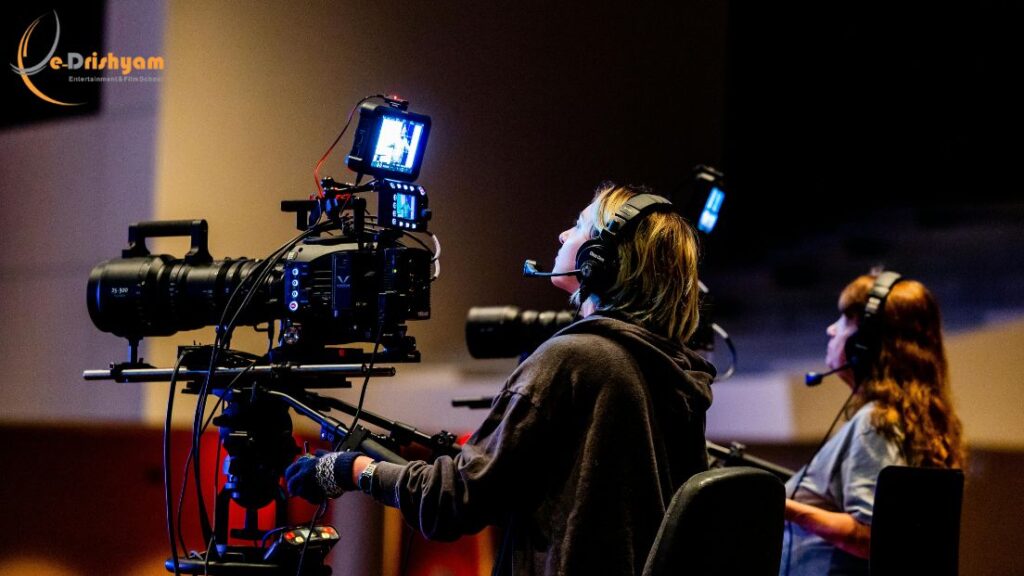
At e-Drishyam, students don’t just learn concepts — they apply them using professional cameras, lighting setups, sound equipment, and industry-standard workflows.
Why This Changes Confidence Completely
Real environments force you to:
- Make decisions quickly
- Deal with imperfect conditions
- Understand cause and effect.
That experience builds a kind of confidence that tutorials can’t. It’s one of the most tangible benefits of the film institute — you don’t just know the process, you’ve lived it.
4. Peer Learning and Creative Ecosystems
Film and media are collaborative industries. No major project is built in isolation.
Self-learning, however, is usually solitary. You evaluate your own work, set your own standards, and rarely get diverse creative input.
At e-Drishyam, students learn alongside editors, cinematographers, designers, and content creators — often at different skill levels.
Why This Matters More Than It Sounds
Creative growth accelerates when you:
- See how others approach the same problem.
- Learn from mistakes that aren’t your own
- Receive feedback from multiple perspectives.
Many professional collaborations also begin during institute days. That network often outlasts the course itself — a long-term benefit of the film institute that keeps compounding.
5. Curriculum Designed for Industry Reality, Not Internet Trends
Views, algorithms, and popularity drive online content — not employability.
At e-Drishyam, the curriculum is shaped by:
- Current industry workflows
- Hiring expectations
- Market demand
That means students don’t just learn tools. They learn:
- How projects move from idea to delivery
- How teams function
- How to communicate professionally
- What clients and studios actually expect
This alignment with reality is a critical benefit of the film institute. It prevents the shock many self-learners face when their “online skills” don’t translate into real jobs.
6. Portfolio Development With Clear Direction and Standards
In the industry, certificates rarely open doors. Portfolios do.
Self-learners often struggle because their portfolios are:
- Inconsistent
- Conceptually weak
- Unclear in intent
At e-Drishyam, portfolio development is intentional. Projects are designed, reviewed, refined, and aligned with industry benchmarks.
Why This Makes a Difference
Recruiters and clients don’t care how you learned. They care about:
- Output quality
- Consistency
- Storytelling ability
One of the most substantial benefits of the film institute is graduating with a portfolio that signals readiness — not experimentation.
7. Career Direction, Exposure, and Realistic Guidance
The most practical benefit of the film institute is clarity after training.
Self-learning rarely answers questions like:
- Which role suits my strengths?
- Should I freelance or seek employment?
- What should my first professional step look like?
At e-Drishyam, students receive career guidance, industry exposure, and honest conversations about:
- Growth paths
- Market realities
- Sustainable career choices
We’ve seen highly skilled self-learners quit simply because they didn’t know where to go next. Institutes exist to bridge that gap.
When Self-Learning Does Work — And When It Doesn’t
To be clear, self-learning has value. It works best when:
- You already have strong fundamentals.
- You know precisely what you’re trying to improve.
- You’re using it to supplement structured training.
But relying only on self-learning in a practical, competitive field like film and media often leads to slow progress and unclear outcomes.
For most serious aspirants, the benefit of the film institute is not convenience — it’s direction.
Final Perspective: Learning With Intent Beats Learning Alone
Film and media careers aren’t built on software knowledge alone. They’re built on judgment, confidence, and real-world understanding.
At e-Drishyam, we’ve watched students transform not because they worked harder — but because they learned with structure, mentorship, and purpose.
If you’re serious about turning creative interest into a profession, joining a film & media institute isn’t a shortcut.
It’s a foundation.
And that, ultimately, is the true benefit of the film institute.