Most people who want to learn video editing start the same way.
They open YouTube, search “how to edit videos,” and spend the next few weeks jumping between tutorials. They learn shortcuts. They learn where to find effects. They learn how to export a file.
And then they wonder why their work still doesn’t look professional.
The problem isn’t effort. It’s what YouTube teaches you how to use tools. It doesn’t teach you how to think like an editor.
That distinction between operating software and actually editing is exactly what separates someone who takes the craft seriously from someone who watched a hundred videos and still can’t deliver consistent work.
A professional video editing course doesn’t just teach you more tools. It rewires how you see footage. It teaches you rhythm, restraint, storytelling, and technical discipline in a structured sequence that builds one skill upon another.
Here’s what that actually looks like in 2026.
Storytelling Through the Timeline
This is where everything begins. And honestly, it’s where most self-taught editors are weakest.
Editing is not assembly. It’s not taking all your clips and putting them in order. It’s deciding, shot by shot, second by second, what the viewer needs to feel right now.
That’s a storytelling decision. Not a technical one.
In a good video editing course, you learn to ask the right questions before you touch the timeline. What’s the emotional arc of this piece? Where should tension build? Where does the audience need to breathe? Which moment is the real climax, and are you actually giving it space to land?
We have seen students arrive with clean footage and good cameras, yet still produce flat, forgettable videos because they never learned to edit with intent.
Once you develop this instinct, everything else becomes a tool in service of the story. Not the other way around.
Non-Linear Editing Workflow
This is the technical foundation every serious editor needs.
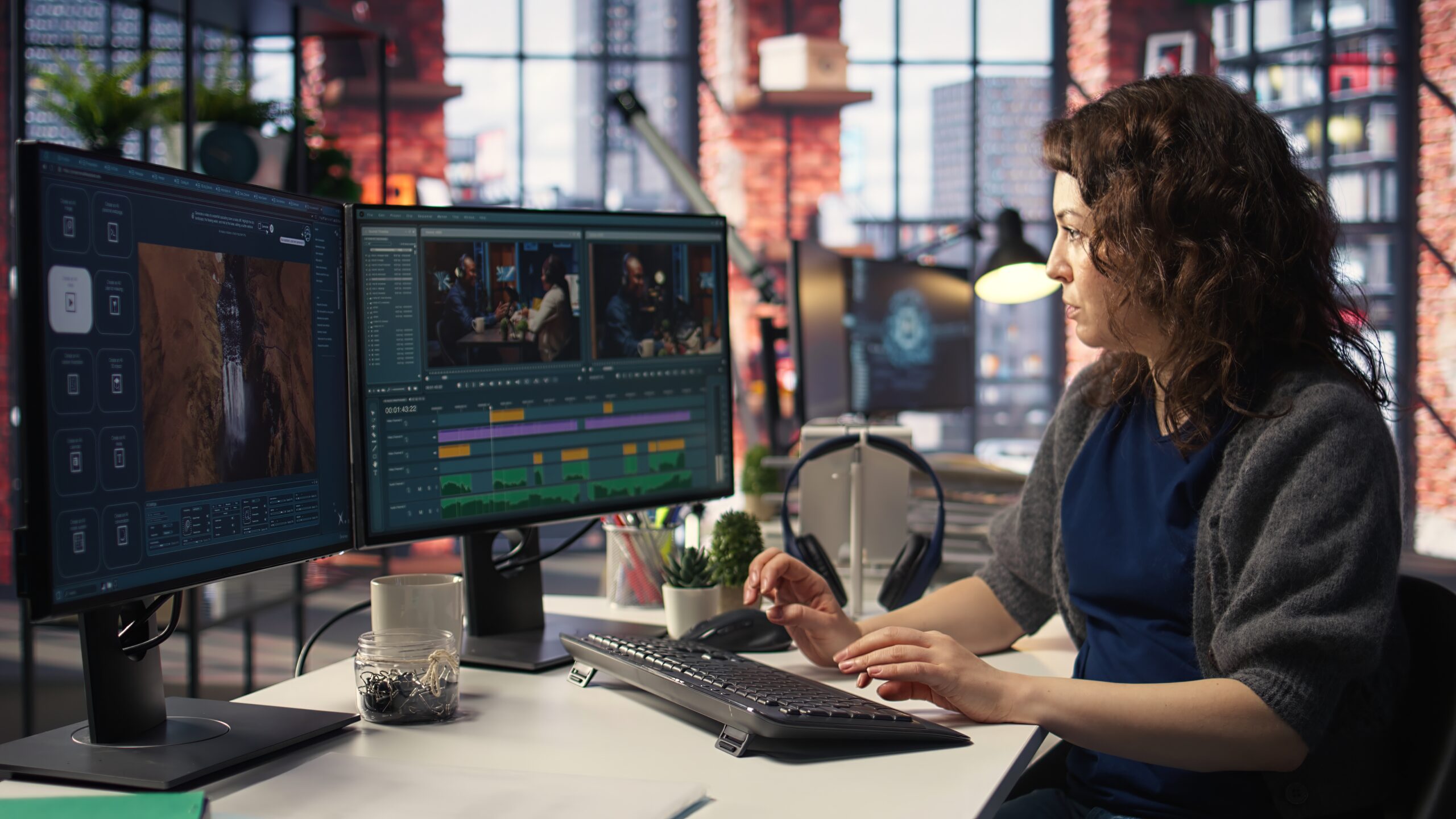
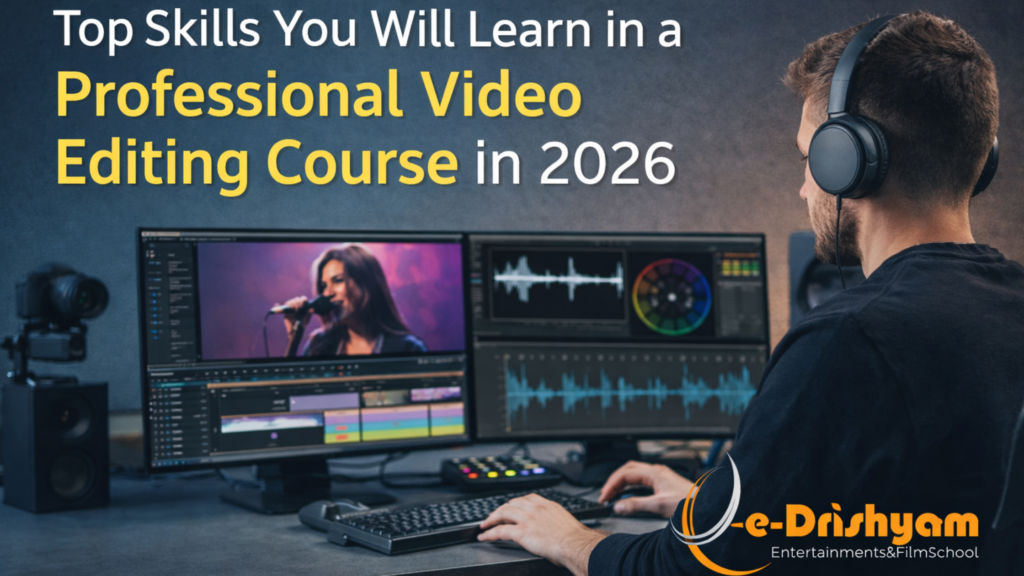
Non-linear editing, working with tools like Adobe Premiere Pro, DaVinci Resolve, or Final Cut Pro, means you can access and rearrange any clip at any point without destroying the rest. Sounds simple. In practice, it’s a discipline.
The best course for video editing doesn’t just show you where the buttons are. It teaches you how to organise a project properly before you start, how to build a workflow that holds up when a client sends you ten additional clips at the last minute, and how to manage timelines that don’t become a cluttered mess by day three.
These are professional habits. And they’re genuinely difficult to build on your own without structure and feedback.
Colour Correction and Colour Grading
Two skills. Both critical. Often confused.
Colour correction is fixing what’s technically wrong, exposure, white balance, skin tones, and consistency across shots. It’s not creative. It’s clinical. You’re asking: Does this footage look like it was shot in the same world?
Colour grading is what comes after. That’s where you make intentional decisions about mood, tone, and visual identity. That’s where your footage starts to feel like it belongs to a specific piece of work.
The rule we repeat constantly: never grade broken footage. A warm LUT applied to underexposed, inconsistent clips doesn’t create atmosphere. It creates a mess.
A professional video editing course teaches you to see colour accurately before you start using it creatively. That’s a skill that takes real time to develop, and real feedback to calibrate.
Audio Editing and Sound Design
Here is something that gets said often because it keeps being true.
Viewers will forgive imperfect visuals. They will not forgive bad audio.
A crackly mic, a music track that’s three decibels too loud, a sudden jump in room tone between cuts, these pull the viewer out instantly. They don’t always know why the video feels wrong. They just feel it and stop watching.
Learning to edit audio properly is a non-negotiable part of the best video editing course. That means noise reduction, dialogue levelling, music automation, using room tone and silence as intentional tools, and understanding how sound and picture work together to create emotion.
This is not an afterthought. It’s half the experience.
Pacing and Rhythm
Pacing is one of those skills that’s very easy to explain and very hard to master.
Shortcuts create urgency. Longer holds create weight. Equal clip lengths create monotony, even when the content is strong.
Editors who understand rhythm don’t edit from habit. They edit from intention. They vary the pace of a sequence the way a good musician varies tempo , not randomly, but in service of what the moment needs.
In our experience, this is one of the last skills to click, but when it does, the quality of someone’s work improves dramatically and almost immediately. You can see it in their timelines. The cuts start to feel considered rather than automatic.
A structured video editing course in Thane or Mumbai builds this skill through practice, critique, and watching a lot of well-edited work with the right guidance on what to look for.
Motion Graphics and Titles
Editing in 2026 doesn’t happen in isolation from design.
Every editor is expected to handle basic motion graphics, lower thirds, title sequences, text animations, and transitions in line with the visual identity. Clients don’t always have a separate motion designer on call. More often, the editor is expected to do it all.
This means understanding After Effects at a working level. Knowing how to build a clean lower third. Knowing when a simple fade is more effective than a complex kinetic title sequence.
The best video editing courses today include motion graphics as part of the curriculum , not as a bonus module, but as a core skill that working editors genuinely need.
Multicam Editing
Live events, panel discussions, interviews, concerts, corporate shoots, and much professional video work involve footage from multiple cameras, all rolling simultaneously.
Multicam editing is a specific workflow skill: syncing footage, switching between angles, maintaining continuity, and making it all feel like a seamless, natural piece of content.
It’s the kind of skill that sounds straightforward until you’re actually staring at a timeline with six video tracks and a client who wants a final cut by Thursday.
Learning it properly, with real multicam footage and real deadlines, is something that only structured training can deliver.
Export, Optimisation, and Platform Knowledge
A video that looks beautiful on a timeline and falls apart on Instagram has failed.
Professional editors in 2026 need to understand output requirements across platforms, such as YouTube, Instagram Reels, OTT, broadcast, and cinema. Different aspect ratios, codecs, bitrates, and colour spaces. What looks right on your monitor in Premiere Pro needs to look right everywhere the client is showing it.
This is unglamorous knowledge. But it’s the difference between a professional and someone who’s still figuring it out.
What a Professional Course Actually Gives You That YouTube Doesn’t
Structure. Sequence. Feedback.
You can find information about every one of these skills online. What you can’t find online is a mentor who watches your edit and tells you exactly why the pacing in the second act falls apart, or why your colour grade looks right on your screen but green on everything else.
At e-Drishyam, our video editing course in Thane is built around the way editors actually develop, not through information overload, but through guided practice, honest critique, and a curriculum that mirrors real production workflows.
The students who come in thinking it’s about software leave understanding it’s about judgment. And judgment is what the industry is always looking for.
If You Are Serious About Editing, Start Right
The skills covered here aren’t advanced. They’re fundamental.
Storytelling, colour, audio, rhythm, motion graphics, multicam, output, these are the things every working editor uses every single week. The best course for video editing isn’t the one with the longest feature list. It’s the one where you actually build these skills deeply, with people around you who can tell the difference between work that’s technically correct and work that’s genuinely good.
If you want to see what that training looks like in practice, we’d love to show you. Come in for a demo session at e-Drishyam, near Thane Station, and get closer to a real editing career than another YouTube tutorial.